
Street Karting in Tokyo with a Photography-Loving Travel Partner: How Much Prep Can You Skip?
Street Karting in Tokyo with a Photography-Loving Travel Partner: How Much Prep Can You Skip?
When your travel partner loves photography, the luggage keeps growing before you even leave: interchangeable lenses, spare batteries, a list of photo spots saved on their phone. Before long, the camera bag is stuffed. But if you add street karting to your Tokyo itinerary, you can leave about half of that prep behind.
Only half, though.
The other half is the kind of prep that, if you skip it, means you won't get to ride on the day. This guide sorts out where to draw that line from the perspective of two people traveling together. It also covers what scenery each location offers and where you can take photos before and after the tour. It's especially for pairs who haven't decided where to go yet.
Prep you can skip: route research and filming plans while driving
First, you can drop route research.
Street Kart runs guided tours, and each location has a set course. You just follow the guide in front of you, so you can skip the whole routine of staring at a map app and asking, "Which road do I take to get this bridge in the background?" Photography lovers tend to spend hours on exactly that. Dropping it alone makes trip prep much lighter.
The trade-off is that you can't detour down an interesting side street on your own during the tour. So if you have a specific view in mind, choose a location whose route passes it. Your research comes down to one decision: which location to book. Simple, and I like it that way.
The next thing you can drop is any plan to take photos while driving.
While you're behind the wheel, your hands and eyes are for driving. Don't hold up your phone while driving. This is exactly the point to make clear to your photography-loving partner before you set out. However carefully you plan your shots for the drive, you'll never get to use them.
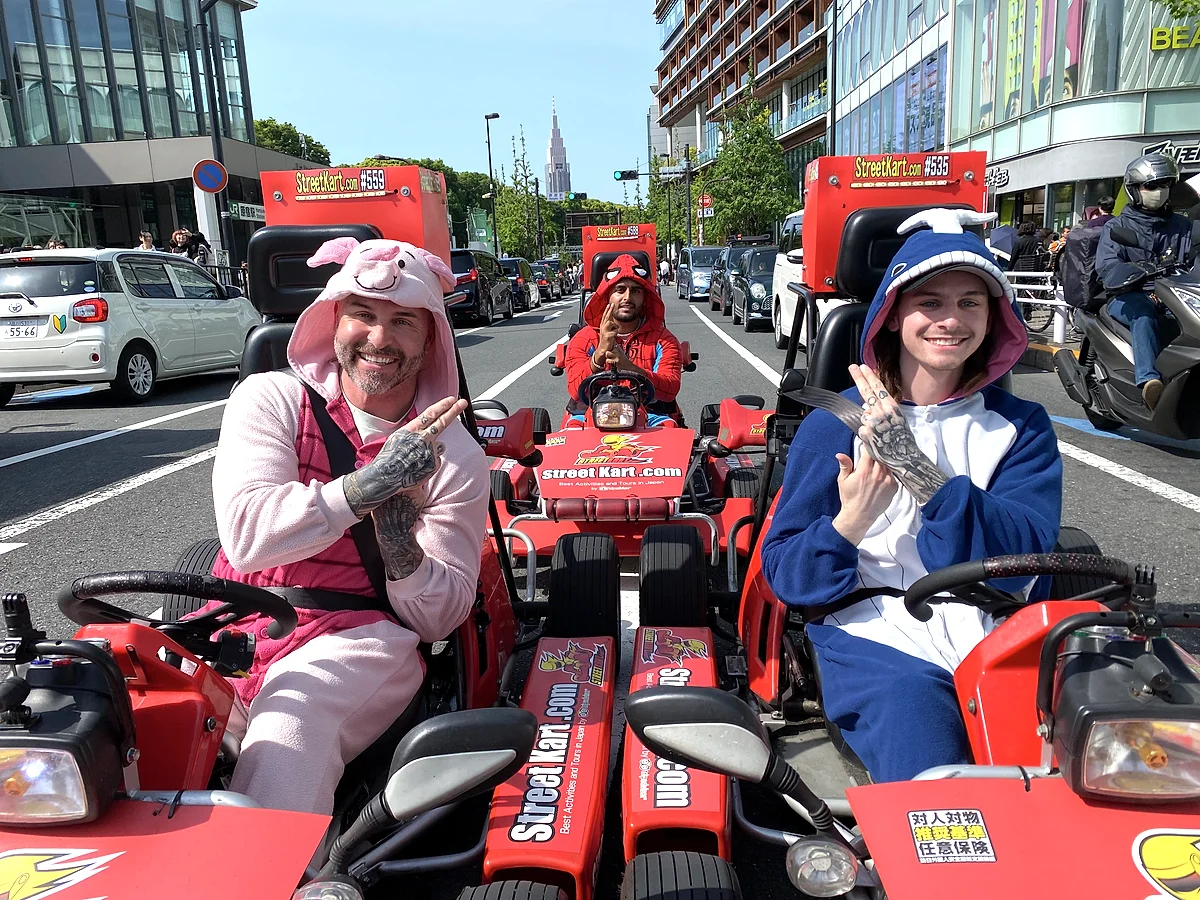
And that's fine. You sit much lower in a kart than you'd expect, and the sounds and wind feel close. The wind shifts as you pass between buildings, and at red lights the chatter from the sidewalk is right beside you. This is time to see with your own eyes, not through a viewfinder. Driving through the city without a camera can be a lot of fun, even for someone who loves photography.
For the photo rules, or whether there are moments to take pictures while stopped, the most reliable source is the staff on the day. Don't expect too much; just ask. That's the right attitude to go in with. Some services may give you photos after the tour, but this varies. If your partner is the type to ask, "If I can't take pictures myself, how will we remember it?", check this when you book.
You can cut down on gear, too. If you won't use it while driving, bring only what you'll need before and after the tour. Hauling a big bag along just leaves you wondering where to put it. If you're concerned about luggage, ask when you book so you don't scramble on the day. According to the provided information, locations have lockers for small items, but they aren't suited to large luggage like suitcases. As a rule of thumb, pack your things into a bag small enough to fit on the kart. Throw in a power bank for walking around and shooting after the tour.
You can also shorten your photo spot list. Instead of saving dozens of spots around Tokyo, pick about three near your location. You probably won't get to more than that anyway. Putting the time you save toward editing back at the hotel will likely leave you more satisfied. Adjusting colors in Lightroom or VSCO can wait for a relaxed evening in your room.
Prep you can't skip: license, reservation, and getting there
From here on, these are things you can't cut.
The most important is your driver's license. Street karts run on public roads, so you need a license that permits you to drive. The conditions, which countries' licenses and which documents are accepted, are detailed, and listing only some of them here could be misleading. They are explained on the official website (kart.st), so be sure to check there.
If you're traveling as a pair, you need to check for both of you. The karts are single-seaters, so your partner will drive too. "I'm the photographer, so I don't need to ride" isn't an option. Spending an hour choosing lenses and then leaving the license documents at the hotel, avoid that at all costs. If you don't have the required documents on the day, you can't participate and won't receive a refund. Get both sets of documents in order before you even think about what goes in the camera bag. Please do your pre-departure checks in that order.
Next is the reservation. Weekends tend to fill up, so if you plan to ride on a weekend, book early. Reservations are accepted via Facebook, LINE, and email, and the contact details are on the official website. Even if your itinerary isn't set yet, you could decide on your riding day first. Planning everything else around that day makes the rest of the plan easier.
A quick word on language. Guidance on the tour day is basically in English. Guidance in Japanese or other languages depends on the staff that day and isn't guaranteed. It's reassuring to talk with your partner beforehand about whether you can both follow English instructions. The official website, for its part, is available in 22 languages.
Clothing is another item you can't skip. Closed-toe shoes (sneakers are recommended) and clothes you can move in easily are recommended, while open-toe shoes, heels, skirts, dresses, and expensive clothing should be avoided. Before choosing outfits that look good in photos just because it's a photo trip, check this first. As for weather, tours run as scheduled in light to moderate rain, and raincoats are provided free of charge. They are canceled in heavy rain or typhoons. If you plan to walk around shooting afterward, it's a good idea to pack a bag to keep your camera dry.
Finally, getting there. The locations have no parking, so take public transportation. Detailed conditions such as clothing and weather policies are also gathered on the official website, so give it a read before you go.
Your choice of location decides the scenery
Street Kart has seven locations in Tokyo. However, Akihabara 1 and Akihabara 2, as well as Shibuya and Shibuya Annex, are essentially in the same spots. If you're choosing by scenery, it's quicker to think in terms of areas.
Scenery listed along the Shibuya and Shibuya Annex routes includes the zelkova-lined avenue of Omotesando, Takeshita Street, and the Shibuya Scramble Crossing. You go from a street lined with architect-designed buildings to one packed with colorful storefronts. What makes this area fun is how quickly the city's colors change over a short distance. The nearest station is Shinsen on the Keio Inokashira Line, a 5-minute walk from the shop.
From Akihabara 1 and 2, you'll see the red-brick Marunouchi Building of Tokyo Station, the Wako clock tower at the Ginza 4-chome intersection, and the signage of Akihabara Electric Town. A station building that opened in 1914 and an electronics district with layer upon layer of signs: scenes from completely different eras appear in a single tour. That's scenery worth seeing. The Marunouchi Building finished its restoration in 2012, and its front facade, in a style known as Tatsuno-style free classic, is listed as a photo point. Akihabara 1 is a 3-minute walk from Suehirocho Station, and Akihabara 2 is a 7-minute walk from JR Akihabara Station.
The signature views from the Shinagawa location are the skyscrapers around Shinagawa Station, the Rainbow Bridge, and Tokyo Tower in the distance. The 333-meter red-and-white tower is at its best when seen from afar, giving you a sense of how vast Tokyo is. It's a 3-minute walk from Kita-Shinagawa Station on the Keikyu Main Line.
The Tokyo Bay location (Shin-Kiba) is in an area that opens out toward the sea. There's the 798-meter Rainbow Bridge, the Odaiba waterfront subcenter, and open bayside roads lined with warehouses. If your partner loves photos with lots of sky, they'll probably love it here. It's an 8-minute walk from Shin-Kiba Station. According to the provided information, evening tours let you enjoy the night views. The Rainbow Bridge is lit up in seven colors at night. Blue sea by day, or a glowing bridge at night: which one you want to see will also decide which time slot to book. Check availability for your preferred time when you reserve.
These are representative sights along each location's route. This article can't promise in what order or from what angle you'll see each one. If there's one view you absolutely can't miss, confirm it when you book.
What if the two of you want different things? Say your partner wants to shoot the Scramble Crossing, and you want to see the fashionable streetscapes. In that case, it helps to separate the scenery you'll see on the tour from the scenery you'll walk to and photograph before or after. At the Shibuya location, for example, you'd drive past Omotesando and Takeshita Street, then walk to the Scramble Crossing to shoot. Rather than cramming two areas into one day, enjoy one area at two distances: driving and walking. That's the plan I recommend.
Take your photos before and after the tour
Since there's no shooting while driving, your photography-loving partner's moment comes before and after the tour. The trick is to stick to places within walking distance of the location. Moving between areas means a big chunk of the day disappears on trains.
From the Shinagawa location, Shinagawa Shrine is a 5-minute walk. A torii gate stands at the top of a stone stairway, and there's also the Twin Dragon Torii, with dragons coiled around its pillars. A vertical shot looking up at the torii from the bottom of the stairs works well even on a smartphone. If you can walk a bit more, Tennozu Isle is 20 minutes away on foot. Art galleries and cafés line the canal, and you can get shots with the water in the foreground. Sengakuji Temple, also a 20-minute walk, is home to the graves of the Ako Roshi (the 47 ronin). Its quiet grounds are a contrast to the brightness of the canal.
From the Akihabara locations, Kanda Myojin is a 10-minute walk. It's known as the guardian shrine of old Edo, and just a short walk from Electric Town, the atmosphere changes completely. The Marunouchi Building of Tokyo Station is also a 20-minute walk, or 5 minutes by train. After the tour, you can go and photograph the red-brick station building, one of the route's highlights, from the front at your own pace. You see a building from the kart's low vantage point, then go back to see it on foot. I really like that flow.
From Shibuya and Shibuya Annex, the Scramble Crossing and the Hachiko statue are a 10-minute walk. For shooting the crossing from above, the second floor of Starbucks and the MAGNET rooftop are listed as photo spots. The moment the light changes, people surge in from all four sides at once. While your partner waits for that instant, the other person can simply relax and watch the crowds flow. It's a pleasant way for two travelers to split the roles.
If you have the energy to walk further, Omotesando is 15 minutes away on foot. You can now photograph the zelkova-lined avenue, also one of the route's highlights, from the sidewalk. If you shoot the tree-lined street to emphasize its depth as it stretches into the distance, you'll capture a different side of it than you saw from the kart. Takeshita Street is also a 15-minute walk. Framing the street's entrance straight on gives you a shot that feels distinctly Harajuku, different from Shibuya.
The Tokyo Bay location keeps the before-and-after plan simple. Taking a break at CASICA, a café and restaurant at Shin-Kiba Station, is about as much as you can comfortably fit in. Odaiba and Toyosu are about 10 minutes away by car, so you'll be able to shoot more calmly if you visit them together at a different time.
In Chinese, taking photos is called "pāizhào." You get absorbed in pāizhào on a trip, and the schedule keeps slipping. Anyone who has traveled with a photography lover knows the feeling. On street karting day, doing this means missing your reservation time. Before the tour there's check-in, which includes a license check, a safety briefing, and an explanation of how to operate the kart and the route. If you're late because you got caught up taking photos, you won't have the breathing room to listen calmly to the briefing. Leave some slack in your schedule before the tour, and do your serious shooting afterward. Just agreeing on that order between the two of you makes the day much more relaxed.
What makes Street Kart appealing
As of November 2023, the combined figures for all locations were more than 150,000 tours run, more than 20,000 reviews, and an average rating of 4.9/5.0. These figures are as of that time.
The first thing to decide is a single location
Your first step is to ask your partner, "What's the one view in Tokyo you most want to photograph?" If the answer is Omotesando, go with Shibuya. If it's the red-brick station building, Akihabara. If it's the sea and the bridge, Shinagawa or Tokyo Bay. Once you've chosen a location, the places to walk before and after, and the station to get off at, fall into place naturally.
After that, check the license requirements for both of you. If you're riding on a weekend, book early. Make sure your clothing matches the recommendations. And on the day, don't get so absorbed in shooting that you miss check-in. That much is prep you can't cut. What you can lighten is route research, plans for shooting while driving, and extra gear. A camera bag one size smaller will do just fine.
Booking contacts and the latest requirements are all on the Street Kart official website.
Put the camera down, look straight ahead, and drive. That time is what makes you put more into the shots before and after. The Tokyo you drive through together will make a memory as good as any photo.
This article was originally written in Japanese and translated using AI. Some expressions may read unnaturally, and we appreciate your understanding. For the most accurate and up-to-date information, please refer to the official site at kart.st.
Street Kart is not affiliated with Nintendo or the Mario Kart series in any way. We do not provide costumes of Nintendo characters, and such costumes may not be worn during tours even if brought by participants.