
Your First Time in Dotonbori, a Route for Two: From the Glico Sign to Hozenji Yokocho and Street Karts in Minamihorie
Your First Time in Dotonbori, a Route for Two: From the Glico Sign to Hozenji Yokocho and Street Karts in Minamihorie
On both sides of the river, signs are stacked on top of each other all the way up the buildings. One shows a runner with both arms raised. A giant crab sticks out from the front of a building, and banners for takoyaki hang everywhere. The first time you come to Dotonbori, it can take a moment to figure out where to look first. Honestly, there's way too much going on. But that "too much" is exactly what makes it fun. That's the kind of place this is.
This article is for couples and pairs of friends who are thinking about a trip to Osaka. It covers one thing: what order to see the Dotonbori area in so you don't get lost. We'll go step by step through where to take photos, when to decide what to eat, and which quieter alleys to find. We'll also cover how to add a street kart tour to your plans. The karts leave from Minamihorie, a little west of Dotonbori.
Where Is Dotonbori? First, Get Your Bearings in "Minami"
Central Osaka's nightlife and shopping districts fall into two main areas, "Kita" (north) and "Minami" (south). Dotonbori sits right in the middle of Minami. Shinsaibashi is to the north, Namba to the south, and Amerikamura and Minamihorie to the west. Keep that layout in mind and you'll open your map app a lot less once you're there.
"Dotonbori" is the name of a single river and the streets along both of its banks. A walkway runs along the water, and one level up, the street is packed with restaurants and signs. If you're coming from Taiwan, picture the energy of Ximending and the street food of a night market, squeezed together along one river. There are some differences, though. Dotonbori's restaurants are inside buildings, and the signs don't spread sideways. They climb upward. This is a city you look up at. Look up until your neck gets a little tired. That's the right way to enjoy it.
If you're coming by train, there are two convenient entry points. From the north, use Shinsaibashi Station on the Osaka Metro (Midosuji Line and Nagahori Tsurumi-ryokuchi Line). From the south, use Namba Station, which is served by the Osaka Metro, Nankai, and Kintetsu lines. For first-timers traveling as a pair, I recommend starting from the Shinsaibashi side. I'll explain why in the next section, but in short, when you come out of the shopping arcade, the river and the signs appear in front of you all at once. You really should experience that moment.
It also helps to know how the name is read. "道頓堀" is pronounced "Dōtonbori." If you try to read the characters 道, 頓, and 堀 one by one as you would in Chinese, you won't get to the Japanese pronunciation. Remember the romanized "Dotonbori" too, since it will help you spot the right signs.
The Route for First-Timers: Down Shinsaibashi-suji to the River, Then Into the Alleys
When you leave Shinsaibashi Station, head into the covered Shinsaibashi-suji Shopping Street and walk south. Clothing shops, drugstores, and candy stores line both sides, and you'll stay dry even when it rains. You'll probably want to start shopping for souvenirs. I get it. But just browse for now and keep walking. Extra bags will get in the way of the photos coming up next.
When the arcade roof suddenly ends, you're in Dotonbori.
Photographing the Glico Sign From Above the River
Past the arcade, you come out onto a bridge over the river. Look along the river from the bridge and you'll see a huge sign on the side of a building showing a runner with both arms raised. That's the Glico sign, Dotonbori's most famous photo spot. The first time you see it, there's a satisfying "oh, there it is" moment.
When you take photos, remember that a steady stream of people is walking across the bridge. The space by the railing tends to fill up with photographers. A practical plan is for one person to hold a spot while the other poses. This is where traveling as a pair pays off.
A few tips. Copying the runner's arms-up pose is the classic shot. If you do it, the photographer should crouch a little and shoot from below. That makes it easier to line up the height of your partner's head with the runner's. A vertical shot fits in the stack of signs above and captures how packed Dotonbori is. A horizontal shot can include the water and the buildings on both banks, giving you a photo that says "this is what this place is like." Take both, one for your Instagram feed and one for Stories, and you won't regret it later.
The scene looks completely different in daylight and after dark. During the day, you can clearly see the colors and shapes of the signs, along with the details of the surrounding buildings. After dark, the lit-up signs take center stage and their colors reflect on the river. Neither one is the right answer. Both are great. Sunset times change with the seasons, so if there's a particular view you want, check the sunset time for that day before you head out.
For hashtags, it can help to mix Japanese and Chinese. Try #道頓堀 #dotonbori #大阪旅行, and add #大阪自由行 in Traditional Chinese.
The Riverside Walkway and the 3D Signs on the Street Above
Take the stairs down near the bridge and you'll find the Dotonbori River Walk running along the water. It's less crowded than the street above, so you can look up at the signs at a calmer pace. From down near the water, the signs seem to hang right over your head, and you'll get different photos than you did from the bridge.
After a short walk along the river, head back up to the street. On Dotonbori's main street, the signs themselves are the attraction.
The first thing you'll notice is the giant 3D crab at Kani Doraku. Its red legs stretch far out from the front of the building, and it's impressive when you stand right underneath and look up. I recommend getting close and shooting from below so the crab's legs fill the top half of the frame. Big things should look big in photos. That's all there is to it.
Another one to look for is Kuidaore Taro, a doll in a red-and-white striped outfit holding a drum. "Kuidaore" is an Osaka word that means enjoying food so much that you spend all your money on it. If you want a close Chinese equivalent, "吃到倒" might be it. People sometimes gather to take photos standing next to him, so allow a little time to wait your turn.
As you walk down the street, you'll smell sauce sizzling on hot griddles and hear shop staff calling out to passersby. This is probably where you'll start debating which place to go into. That indecision is part of the Dotonbori experience, too.
Decide What to Eat First, Then Finish at Hozenji Yokocho
The thing that eats up the most time in Dotonbori is deciding where to eat. If you're traveling as a pair, it's much easier to roughly agree before you start walking whether you want takoyaki, ramen, or okonomiyaki.
For takoyaki, there's Kukuru, which has a shop in Dotonbori. Takoyaki is an Osaka staple: batter cooked crisp on the outside, with a soft, gooey center and a piece of octopus inside. In Chinese it's written "章魚燒," so visitors from Taiwan will recognize it right away. Fresh off the griddle, the inside is extremely hot, so for the first bite, break one in half and let the steam out first. This really matters. Burn your mouth and the rest of the day's food crawl is ruined.
For ramen, Dotonbori has Kinryu Ramen and Ichiran Dotonbori. If you'd like to sit down for okonomiyaki, Mizuno in Shinsaibashi and Chibo, a short walk away, are good choices.
Share one plate of takoyaki, then get one more dish somewhere else. The nice thing about coming as two is that you can split portions that would be too much for one person. If you share every plate, you can hit one more restaurant with the same stomach space. On a trip where you want to make the most of your time, sharing like this works really well.
Once you're comfortably full, head to Hozenji Yokocho, just a short walk from Dotonbori. Traditional Japanese restaurants line a narrow stone alley, and as soon as you step away from the bright, crowded riverside, you can feel the atmosphere change. After all that time looking up at signs, walking this alley makes you realize that Minami has places like this too. It's got a real mood to it. I think this is a place to save for a slow stroll rather than for taking photos.
From there, continue toward Namba, where you'll also find Namba Grand Kagetsu and Namba Parks. Enter at Shinsaibashi and exit at Namba. That's the one-way route for two first-timers to walk the whole of Dotonbori.
Adding a Kart Tour on a Tight Schedule: Planning Around Minamihorie
After you've walked Dotonbori, you might want to see Minami from a different angle. If so, Street Kart's Osaka location is an option. The shop is in Minamihorie, about a 20-minute walk from Dotonbori. Amerikamura is about 5 minutes on foot from the shop, and Shinsaibashi is about 15 minutes. The nearest stations are Nishi-Ohashi (about a 3-minute walk) and Yotsubashi (about a 5-minute walk), both on the Osaka Metro.
First, one important point. Street Kart runs guided tours, and each location has its own set courses. You don't pick where you want to go and drive there yourself. The Osaka location's route materials list Minami areas such as Amerikamura, Shinsaibashi, Dotonbori, and Namba. Check the official website (kart.st) for route details.
That makes planning simple. Treat walking Dotonbori and the kart tour as two separate things.
Option one: ride the karts first, then walk Dotonbori. After the tour takes you through the streets of Minami, walk down Shinsaibashi-suji to the river, then move on to the Glico sign and your food crawl. You get to retrace the city you just drove through, this time on foot. I'm a big fan of doing it in this order.
Option two: walk Dotonbori first, then head to Minamihorie. Once you've finished taking photos in Dotonbori, walk through Amerikamura to Minamihorie and join your tour. You'll pass Triangle Park and the streets lined with vintage clothing shops, so the walk over counts as sightseeing too. Tours have a set booking time, though. To avoid running late because lunch went long, decide ahead of time when you'll leave the restaurant.
Either way, the shop has no parking. Please get there by train or other public transportation.
While driving, focus on the road. The realistic split for a pair is to save phone photos for the walking part of the day. Get all the shots you want while you're exploring Dotonbori on foot.
What Makes Street Kart Different for Two People Who've Already Walked Minami
First, a guide leads the way. A trained guide drives in front and leads you along the route. In a city you don't know, you don't have to check a map and figure out which corner to turn at. Just follow the guide and focus on the road in front of you. That's a real relief.
Second, there's the feel of the ride itself. You'll see the same streets of signs you were just looking up at from the sidewalk, but now from the flow of traffic, with your own hands on the wheel. It's the same Minami, but it looks completely different. That feeling is hard to describe until you try it. So give it a try. That's the quickest way to understand.
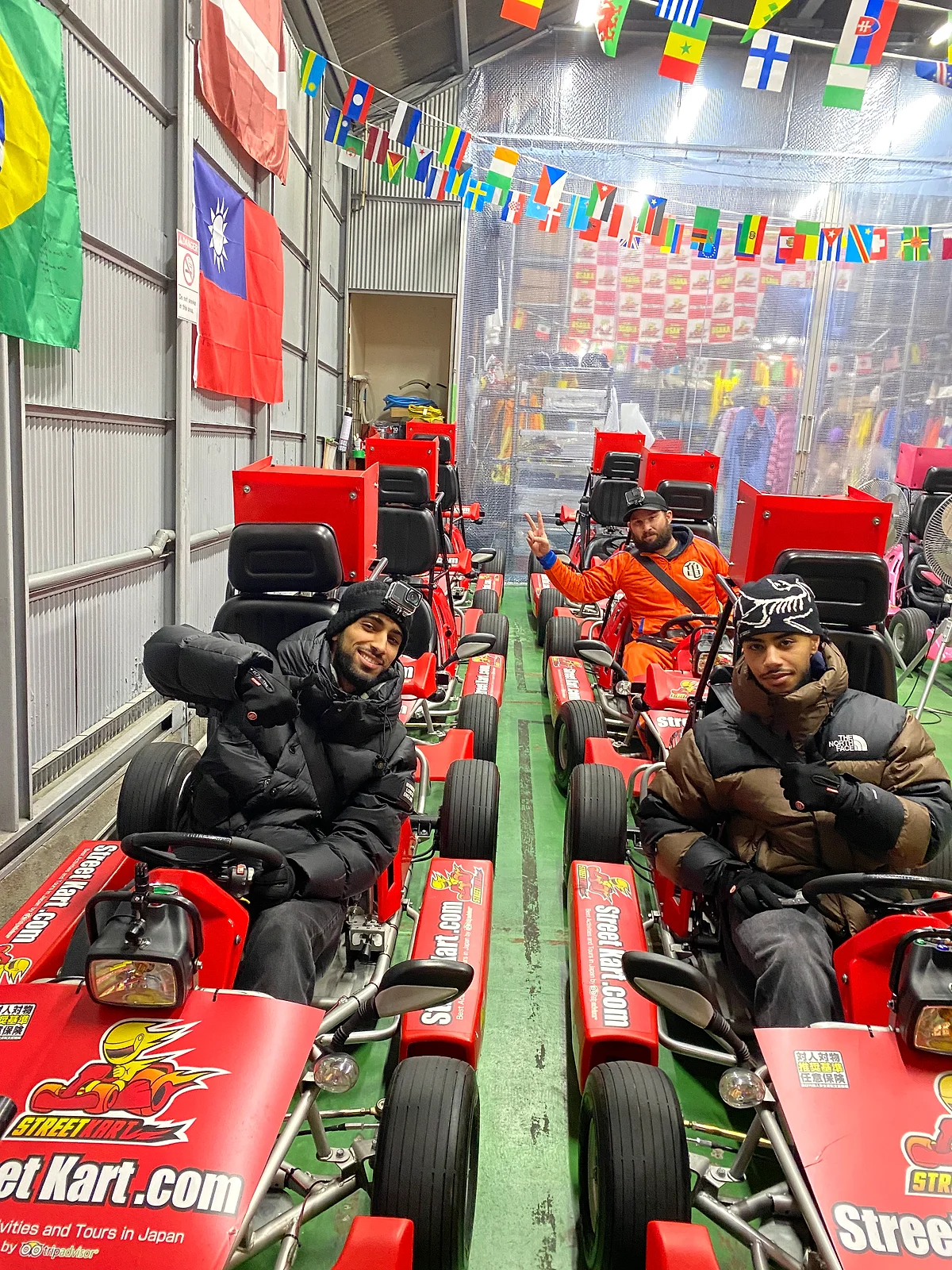
Third, the karts are single-seaters. If the two of you join together, you each get your own steering wheel. Instead of watching the scenery from the passenger seat, you both drive the same streets. You follow your partner through the city, watching them just ahead of you. That's likely to become one of the best memories of your trip together.
Fourth, the shop is close to the Minami sights. From the Minamihorie shop, Dotonbori is about a 20-minute walk and Amerikamura about 5 minutes. Work out together how to fit walking tours and the kart tour into the same day.
Fifth, language support. On the day of the tour, guidance is generally given in English. Guidance in Japanese or other languages depends on the staff working that day and isn't guaranteed. Plan on English explanations. The official website is available in 22 languages. If you'd like guidance in another language, contact them in advance through the official website.
Sixth, their track record. As of November 2023, across all locations, they had run more than 150,000 tours for over 1.34 million customers, collecting more than 20,000 reviews with an average rating of 4.9/5.0. There are 9 locations across Japan (7 in Tokyo, 1 in Osaka, and 1 in Okinawa). If you're riding in Osaka, the Minamihorie shop is the only one.
What to Check Together Before You Book
If you're still deciding where to go, there are a few things worth checking before you book.
The most important is your driver's license. To drive a kart, you need a license that meets the requirements. The rules depend on your country and the type of license, so be sure to check the requirements for both of you on the official website (kart.st). You don't want to find out that one of you can ride and the other can't. See the official website for details.
Next is your schedule. Weekends book up quickly, so if you'll be in Osaka on a weekend, book early.
Reservations are accepted via Facebook, LINE, and email (booking@streetkart.com). Prices vary by season and time slot, so check the official website (kart.st) for current rates. Read the official information about tour length and weather policies before you book, too, so you won't be caught off guard on the day.
Finally, a note about what to carry on your Dotonbori day. The bridge and the walkway are both crowded, and it's hard to take photos with your hands full. If you agree to buy all your souvenirs at the end, once you reach Namba, you can walk around with less to carry.
Walk south down Shinsaibashi-suji, and when the arcade ends, the river and the signs appear in front of you. Photograph the Glico sign, stroll the riverside walkway, split a plate of takoyaki, and catch your breath in Hozenji Yokocho. It's all simple, straightforward fun. And if you find yourselves wanting to drive through the same Minami streets with your own hands on the wheel, start by checking the license requirements for both of you and finding an open date. You walked these streets looking up, and now you get to see them from behind the wheel. That's a day you're going to love.
This article was originally written in Japanese and translated using AI. Some expressions may read unnaturally, and we appreciate your understanding. For the most accurate and up-to-date information, please refer to the official site at kart.st.
Street Kart is not affiliated with Nintendo or the Mario Kart series in any way. We do not provide costumes of Nintendo characters, and such costumes may not be worn during tours even if brought by participants.